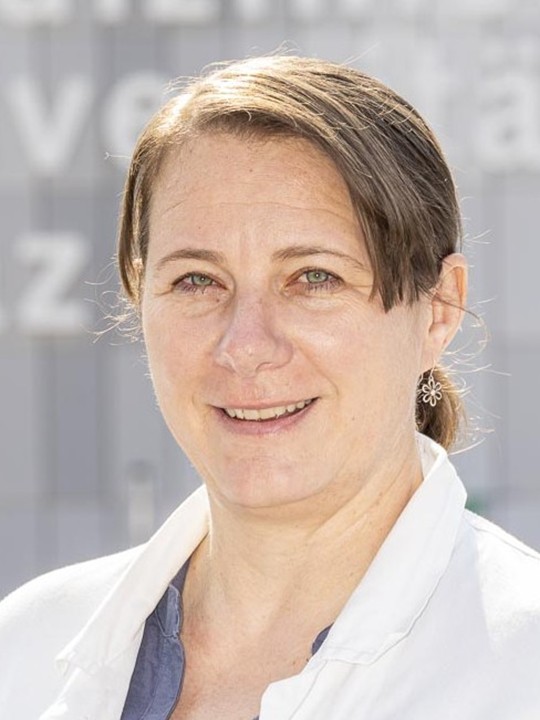
As a steering committee member of the European Liquid Biopsy Society, she advocates for standardization and guidelines of LB approach es to enable a widespread clinical use. Ellen Heitzer works at the Institute for Human Genetics in Graz, AUSTRIA , where she is heading the Research Unit for “ Liquid Biopsies for personalized medicine in cancer ”. Professor Heitzer is particularly intereste d in circulating tumor DNA (ctDNA) and her group has developed and applied a set of techniques for the analysis of ctDNA to non - invasively investigate tumor evolution or use ctDNA as a response marker . Her expertise has been recognized internationally, whi ch is reflected by the invitations to international congresses or reviews in international journals . As a steering committee member of the European Liquid Biopsy Society (ELBS) she advocates for the standardization and guidelines of LB approaches to enabl e a widespread clinical use. As an EU registered Clinical Laboratory Geneticist and head of the molecular genetics branch of the D &F Institute for Human Genetics, Prof. Heitzer is also involved in routine diagnostics of hereditary diseases with a special focus on familial tumor syndromes
Tuesday 09 June 2026
| Time |
Session |
|
|
13:30
14:15
|
This session, sponsored by biomodal, will introduce the duet cfDNA solutions as complete integrated genetic and epigenetic workflows and software. The duet cfDNA solutions unlock the broadest spectrum of biomarkers, with market leading accuracy, from a single low input cfDNA sample, enabling ultra-low LoD for the detection of ctDNA. Talks will demonstrate how, in a liquid biopsy setting, 6-base data detects cancers earlier than other methylation sequencing approaches across multiple cohorts. Additional data will show how 6-base data enables a better understanding biological mechanisms of prostate cancer treatment response than existing liquid biopsy approaches.
-
-
duet cfDNA solutions are complete integrated genetic and epigenetic workflows and software that unlock the broadest spectrum of biomarkers from a single low input cfDNA sample. The workflows have been engineered for cfDNA applications to maximise the recovery of unique cfDNA molecules. Coupled with the full complement of biomarkers on each DNA fragment, duet cfDNA enables ultra-low LoD for the detection of ctDNA. The solution provides market-leading 6-base genetic and epigenetic accuracy, including the ability to distinguish 5mC from 5hmC, coupled with fragmentomic information. Providing a full complement of biomarkers on each DNA fragment enables ultra-low LoD for the detection of ctDNA. 6-base data has been shown to detect cancer earlier than other methylation sequencing approaches in multiple cohorts. Furthermore, analysis of cfDNA from a combination therapy clinical trial has demonstrated the power of the 6-base genome for better understanding the biological mechanism of prostate cancer treatment response.
-
Early detection of prostate cancer is challenged by low circulating tumor DNA (ctDNA) levels, limiting sensitivity. We evaluated whether combining methylation and fragmentomic features from cell-free DNA (cfDNA) improves detection. cfDNA from prostate cancer patients across disease stages and healthy controls was analyzed using a multiomics approach assessing 5mC, 5hmC, and fragmentomic features. Methylation signals reflected tumor biology but were less sensitive in localized disease, whereas fragmentomics provided more consistent discrimination across stages. Overall, fragmentomics offers a robust basis for early detection, and integrating both marker types is expected to further increase sensitivity and improve non-invasive prostate cancer diagnostics.
EllenHeitzer
Industry Speaker
Medical University of GrazAustria
Room F6+7+8
|